Direct Factory for Custom Channel Letters | Global Shipping Services

Illuminated Letters Installation and Wiring Guide
Illuminated letters installation is not only the final step after production. It is part of the complete signage design. A beautiful set of LED channel letters can still create problems if the mounting template is unclear, the wall condition is not checked, the cable route is too long, the power supply is placed in the wrong location, or outdoor wiring is not protected from water.
For international signage projects, the buyer, designer, contractor, and manufacturer should confirm installation details before the sign is built. This helps the factory design the right mounting structure, LED layout, power supply plan, wiring exits, waterproof details, and packing method.
In this guide, Retay Sign explains the key installation and wiring points buyers should understand before ordering custom illuminated letters, LED channel letters, backlit letters, light box signs, and other commercial illuminated signs.
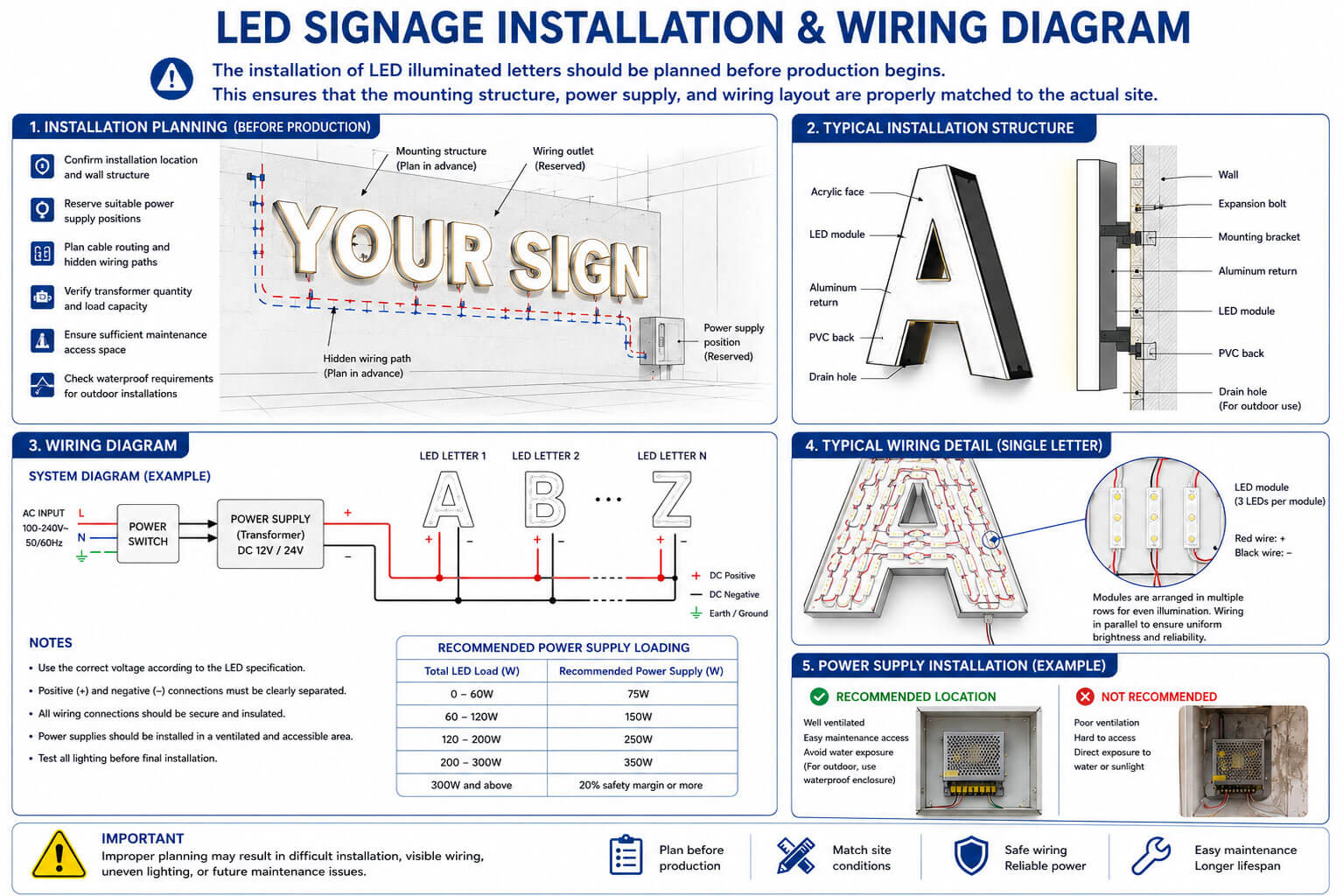
Table of Contents
- Why illuminated letters installation should be planned early
- Confirm the wall, size, and installation environment
- Choose the right mounting method
- Use a 1:1 installation template
- Plan 12V or 24V low-voltage LED sign wiring
- Decide the power supply location
- Control voltage drop and cable distance
- Protect outdoor wiring from water
- Confirm the wiring diagram before shipment
- Test the sign before and after installation
- Common installation and wiring mistakes
- What to send before ordering illuminated letters
- FAQ
Why Illuminated Letters Installation Should Be Planned Early
Many buyers think installation starts when the sign arrives on site. In reality, LED channel letters installation should be discussed before quotation and production. The installation method affects the letter back structure, screw positions, wiring exits, cable length, power supply selection, and even the packaging.
For example, a set of front-lit channel letters mounted directly on a concrete wall may need studs, wall anchors, a drilling template, and rear cable exits. A backlit letter set may need spacers to create an even halo effect. A sign mounted on a raceway or backer panel may need a different cable route and a stronger supporting structure.
If these details are confirmed late, the installer may need to modify the sign on site. That can increase labor cost, damage the finish, weaken waterproof protection, or cause uneven lighting. Early planning helps the sign arrive ready for the actual wall, power location, and installation method.
For custom projects, Retay Sign usually recommends confirming these points before production:
- Final sign size and letter height
- Wall material and wall thickness
- Indoor or outdoor installation
- Mounting height and access conditions
- Power input voltage in the destination country
- Distance from the sign to the power supply
- Whether the sign needs front-lit, backlit, side-lit, or RGB lighting
- Whether the installer needs a template, wiring diagram, or shop drawing
You can also review our Engineering & Shop Drawings service if your project needs clearer installation planning before production.
Confirm the Wall, Size, and Installation Environment
The wall condition decides how the illuminated sign installation should be designed. A glass wall, brick wall, concrete wall, aluminum composite panel, drywall, wooden wall, and steel frame all require different mounting hardware and different drilling methods.
Outdoor walls also create additional requirements. Rain, wind, dust, UV exposure, temperature changes, and maintenance access should be considered. A sign installed on a high building facade may need stronger fasteners and safer wiring access than a small indoor reception logo.
Before ordering illuminated letters, send the supplier clear installation photos. A straight front photo of the wall helps confirm the sign size and visual proportion. A close-up photo helps identify the surface material. If possible, mark the desired sign position, available power position, wall thickness, and any obstacles such as beams, glass joints, pipes, or existing cables.
The sign size should match both branding needs and installation reality. Large letters may look impressive, but they also need stronger mounting points, more LED modules, larger power capacity, and better cable planning. Small letters may need more careful fabrication because thin strokes and tight corners leave less space for LED modules and wiring.
For buyers comparing different sign types, Retay Sign’s Channel Letters and Light Box Signs pages can help you understand common structures and mounting options.
Choose the Right Mounting Method
There is no single mounting method that fits every project. The right method depends on the wall surface, sign size, lighting type, maintenance needs, and local installation practice.
Stud Mounting
Stud mounting is common for individual metal letters, acrylic letters, and LED channel letters. Threaded rods or studs are fixed to the back of each letter, then inserted into drilled holes in the wall. This creates a clean appearance because the fixing points are mostly hidden behind the letters.
Stud mounting is suitable for many storefronts, office walls, hotel signs, restaurant logos, and commercial building signs. It usually requires accurate drilling, so a 1:1 paper template is very helpful.
Spacer Mounting for Backlit Letters
Backlit letters need space between the letter and the wall so the light can reflect and create a halo effect. Spacers keep the letters at a consistent distance from the surface. If the spacer depth is uneven, the halo lighting may look inconsistent.
For halo-lit signs, the wall color and surface texture also matter. A light-colored, matte wall usually reflects the halo more evenly than a dark, glossy, or uneven wall. This is why installation photos are useful before production.
Raceway Mounting
A raceway is a long metal box behind the letters. It can hold wiring and power supplies, reducing the number of holes needed in the wall. Raceway mounting is useful when the wall cannot be drilled many times, when the landlord wants fewer penetrations, or when the electrical components need to be grouped in one place.
The tradeoff is visual appearance. A raceway is visible behind the letters unless it is painted to match the wall. For some storefronts, this is acceptable and practical. For premium interior branding, individual hidden wiring may look cleaner.
Backer Panel Mounting
A backer panel supports the letters as one complete sign set. It can simplify installation and help align complex logos. Backer panels are also useful for uneven walls or temporary installations.
The panel material, thickness, color, and fixing method should be confirmed before production. For outdoor projects, the panel must be strong enough for wind load and weather exposure.
Use a 1:1 Installation Template
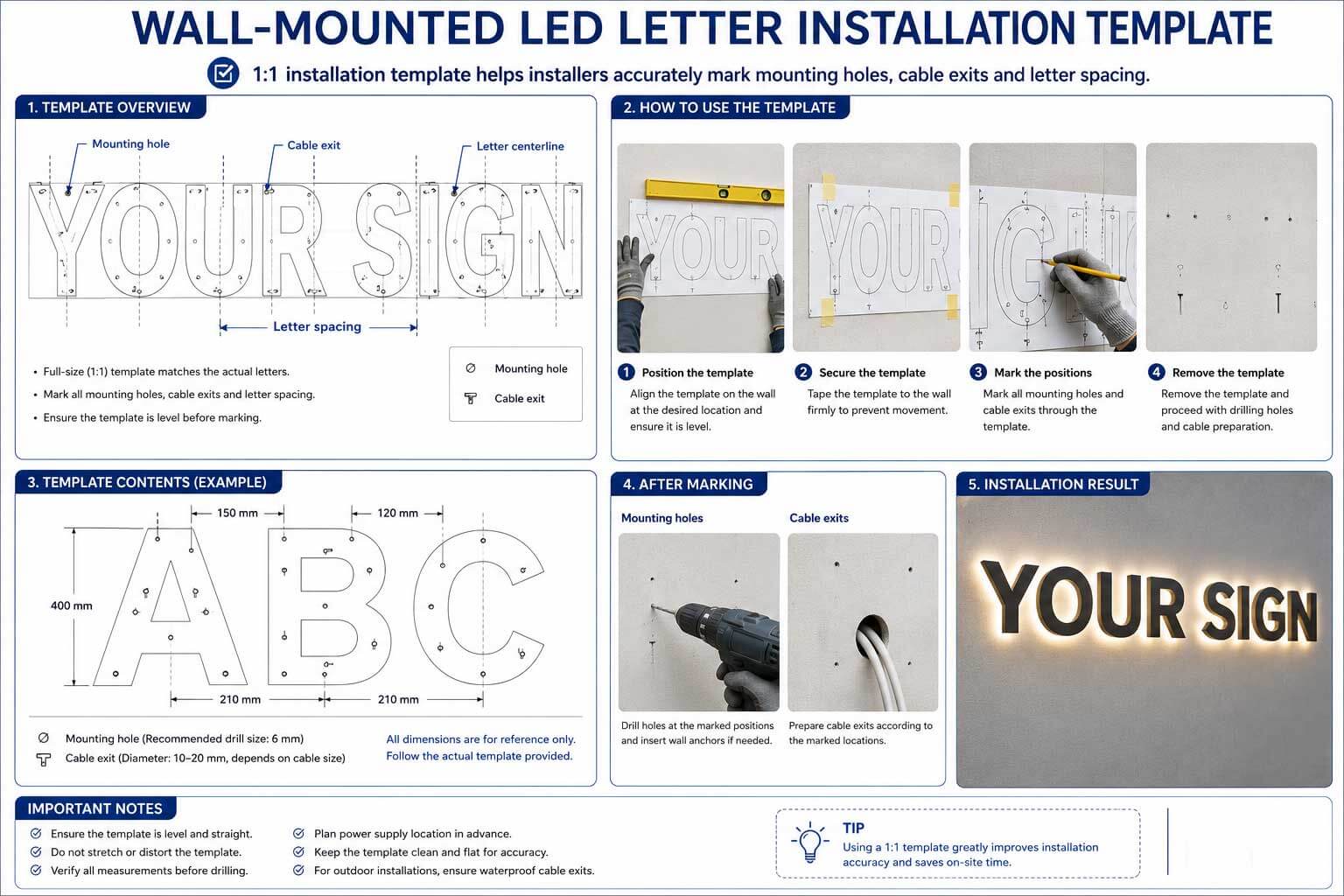
A 1:1 installation template is one of the simplest ways to reduce mistakes. It shows the exact letter position, drilling holes, cable exits, and overall layout at full size. Installers can tape the template to the wall, check alignment, mark holes, drill, and then mount the letters.
For illuminated letters installation, a good template should include:
- Overall sign width and height
- Letter spacing and logo position
- Mounting hole locations
- Cable exit locations
- Center line or baseline
- Recommended installation direction
- Project name or drawing number
The template should match the final production file. If the design is changed after the template is made, the template must be updated too. Even small changes in letter spacing can create visible alignment problems on the wall.
For large signs, the template may be printed in sections. Each section should have clear matching marks so the installer can assemble it accurately on site. If the sign is very large, a digital shop drawing with measured reference points may be used together with the printed template.
Plan 12V or 24V Low-Voltage LED Sign Wiring
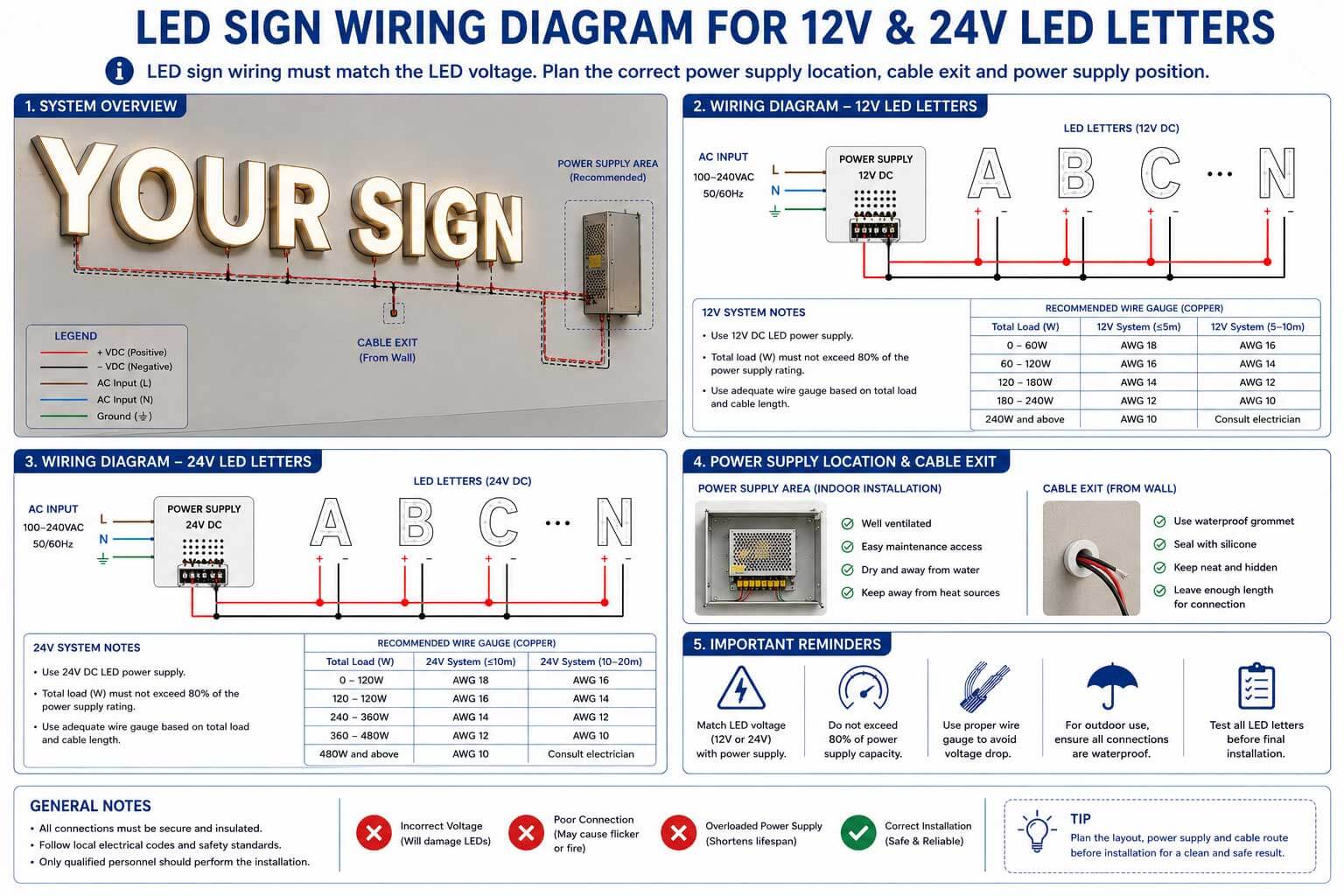
Most illuminated letters use low-voltage LED systems such as 12V DC or 24V DC. The exact voltage depends on the LED modules, sign size, cable distance, and supplier design. The power supply converts building electricity into the low-voltage output required by the LED modules.
LED sign wiring must match the LED voltage. A 12V LED module should use a 12V power supply. A 24V LED module should use a 24V power supply. Mixing the wrong voltage can damage the LEDs or create unstable brightness.
For simple white illuminated letters, the wiring is usually straightforward. For RGB letters, RGBW signs, or programmable letters, the wiring design becomes more complex because controllers, signal cables, zones, and power injection may be required. In those cases, the wiring diagram should be confirmed before shipment.
Even though many LED signs are low voltage, electrical safety is still important. Building-side electrical connections should follow local codes and be handled by qualified electricians or licensed installers when required. Buyers should not treat low-voltage signage as a reason to ignore electrical standards.
You can learn more about electrical safety certification from UL Solutions, which is widely referenced for product safety and electrical component compliance.
Decide the Power Supply Location
The power supply location affects installation cost, maintenance access, cable length, voltage drop, waterproofing, and appearance. It should be planned before production, not guessed after the sign arrives.
Common power supply locations include:
- Inside a raceway behind the letters
- Inside the wall or behind an access panel
- Above a ceiling
- Inside a protected electrical box
- Behind a backer panel
- In a nearby service area
Each option has advantages and limits. A power supply inside a raceway is easier to match with the sign, but the raceway may be visible. A hidden power supply looks cleaner, but the installer must keep it accessible for future maintenance. Outdoor power supplies need proper protection, ventilation, and cable sealing.
The power supply should not be sealed in a place where heat cannot escape. Heat reduces lifespan and can lead to early failure. It should also not be placed where water can collect. For outdoor illuminated letters, a waterproof or weather-protected electrical box is often needed.
When the power supply is far away from the sign, the cable route and cable size become more important. Long cable runs can reduce voltage and cause uneven brightness.
Control Voltage Drop and Cable Distance
Voltage drop happens when electrical power loses strength over cable distance. In illuminated letters, voltage drop can make some letters look dimmer than others, especially if the power supply is far from the sign or the cable is too thin for the load.
Voltage drop is affected by:
- Cable length
- Cable thickness
- LED power consumption
- Total load on one circuit
- 12V or 24V system choice
- Wiring layout and connection method
For larger signs, the supplier may divide the sign into several power zones. Each zone receives power more evenly, which helps maintain consistent brightness. Power injection can also be used for long LED runs, especially in large channel letters or programmable signs.
24V systems are often useful for longer cable distances because they can reduce voltage drop compared with 12V systems in many layouts. However, the LED modules and power supplies must be designed as a matching system.
Buyers do not need to calculate every wiring detail themselves, but they should provide enough project information. The supplier needs to know the sign size, LED type, installation height, power supply location, and approximate cable distance.
Protect Outdoor Wiring from Water
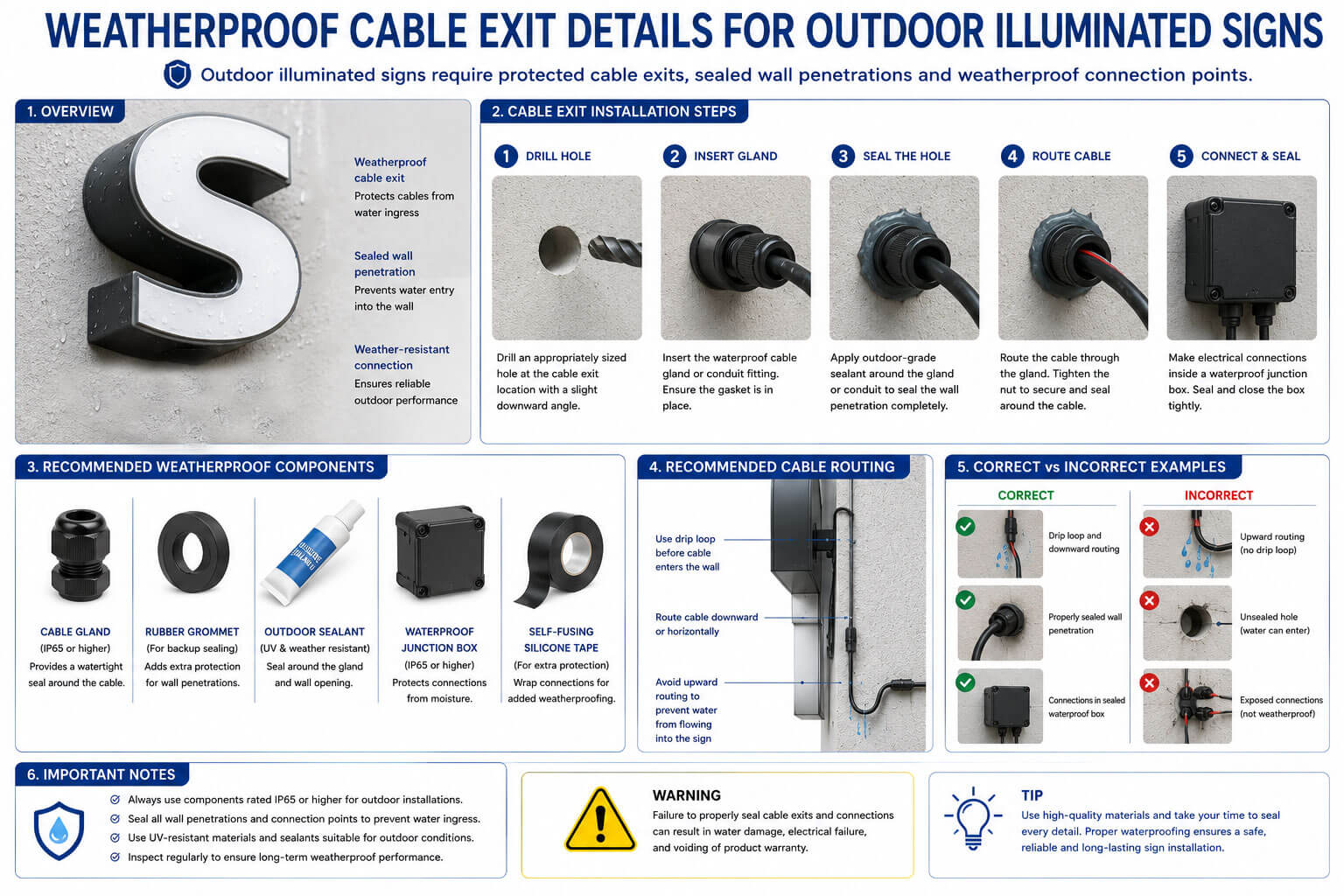
Outdoor illuminated sign installation needs careful waterproof design. Water can enter through cable exits, screw holes, wall penetrations, seams, connectors, or poorly sealed power boxes. Once water reaches LED modules, connectors, or power supplies, the sign may flicker, short circuit, corrode, or fail early.
Waterproofing is not only about choosing outdoor LED modules. The complete installation system must be protected.
Important waterproof details include:
- Downward-facing cable exits when possible
- Sealed wall penetrations
- Waterproof connectors or properly protected joints
- Drip loops where suitable
- Silicone sealing around screw holes and cable exits
- Outdoor-rated power supplies or protected electrical boxes
- Proper drainage so water does not sit inside the sign
For outdoor signs, installers should avoid leaving exposed wire joints behind letters or inside areas where rain can reach. Cable connections should be protected according to the site environment and local electrical requirements.
After installation, the sign should be checked during both daytime and nighttime. Daytime inspection helps confirm sealing, alignment, and surface finish. Nighttime inspection helps confirm brightness, halo effect, color consistency, and any flickering.
Confirm the Wiring Diagram Before Shipment
A clear wiring diagram helps the installer understand how the sign should be connected. This is especially important when the sign includes multiple letters, multiple power supplies, RGB controllers, dimmers, timers, or long cable runs.
A practical LED sign wiring diagram should show:
- Input voltage and output voltage
- Power supply quantity and wattage
- Positive and negative output connections
- Letter grouping or power zones
- Controller position if RGB or programmable lighting is used
- Cable exit positions
- Recommended connection order
- Notes for waterproof protection
For simple signs, the diagram may be basic. For complex signs, the diagram should be more detailed. The goal is to reduce guesswork on site. If the installer has questions, it is better to ask before connecting power.
Retay Sign can provide wiring support as part of custom signage manufacturing. This is also connected with our Quality Control process, because illuminated signs should be tested before packing.
Test the Sign Before and After Installation
Testing should happen at two stages: before shipment and after installation.
Before shipment, the factory should test the sign to confirm that the LEDs work, the brightness is even, the color temperature is correct, the wiring is stable, and the power supply matches the design. For custom illuminated signs, a lighting test photo or video can help the buyer confirm the result before delivery.
After installation, the installer should test the sign again before final sealing and cleanup. This helps catch loose connections, reversed polarity, voltage drop, damaged cables, or installation-related issues.
A practical installation test includes:
- Check that every letter lights correctly
- Check for flickering or weak brightness
- Confirm consistent color temperature
- Confirm RGB or programmable effects if included
- Check that wires are protected and not pinched
- Confirm power supply ventilation and access
- Inspect waterproof sealing on outdoor signs
- Take daytime and nighttime photos for records
If one section does not light, turn off power before checking connections. Do not repeatedly power a sign with suspected wiring problems, because incorrect wiring can damage LEDs, controllers, or power supplies.
Common Installation and Wiring Mistakes
Many illuminated sign problems come from small installation decisions. Avoiding these mistakes can save time and reduce after-sales issues.
Common mistakes include:
- Starting production before confirming the wall and power location
- Not using a 1:1 installation template
- Drilling holes without checking the full layout
- Using the wrong power supply voltage
- Placing the power supply too far from the sign
- Ignoring voltage drop on long cable runs
- Using indoor components in outdoor conditions
- Leaving outdoor wire joints exposed
- Sealing the power supply where heat cannot escape
- Making the power supply impossible to access later
- Installing backlit letters too close to the wall
- Not testing the sign before final sealing
These issues can cause uneven brightness, water damage, difficult maintenance, visible alignment errors, and early LED failure. The best solution is to confirm installation details before production and provide the installer with a clear template and wiring guide.
What to Send Before Ordering Illuminated Letters
To help your supplier design the correct illuminated letters installation plan, send as much project information as possible. Complete information reduces back-and-forth communication and helps avoid wrong assumptions.
Before ordering, prepare:
- Logo file in AI, PDF, EPS, CDR, or high-resolution format
- Required overall sign size or letter height
- Installation wall photo
- Wall material if known
- Indoor or outdoor use
- Desired lighting type: front-lit, backlit, side-lit, RGB, or non-illuminated
- Local input voltage, such as 110V or 220V
- Preferred power supply location
- Approximate distance from power supply to sign
- Mounting preference, such as studs, spacers, raceway, or backer panel
- Any landlord, contractor, or local code requirements
- Required certificates if applicable
If you are not sure which mounting method is best, send site photos and project requirements. A signage manufacturer can recommend a structure based on the wall, sign size, lighting effect, and installation environment.
Installation Planning Checklist
| Item | What to Confirm | Why It Matters |
|---|---|---|
| Wall condition | Material, thickness, surface, obstacles | Determines mounting hardware and drilling method |
| Sign size | Overall width, height, letter depth | Affects structure, LEDs, power, and packaging |
| Lighting type | Front-lit, backlit, RGB, programmable | Changes wiring and power design |
| Power location | Raceway, wall cavity, ceiling, electrical box | Affects cable distance and maintenance access |
| Voltage | 12V or 24V LED system, local input voltage | Prevents electrical mismatch |
| Waterproofing | Outdoor rating, cable exits, connectors, sealing | Reduces water damage risk |
| Template | 1:1 drilling template or shop drawing | Helps accurate alignment |
| Testing | Factory test and site test | Confirms stable lighting before final handover |
FAQ
Can customers install illuminated letters themselves?
Some small indoor signs may be simple to mount, but illuminated letters installation often involves drilling, alignment, low-voltage wiring, and connection to building power. A qualified local installer or electrician is recommended, especially for outdoor signs, large signs, high-mounted signs, or projects with local code requirements.
Do illuminated letters need a wiring diagram?
Yes. A wiring diagram is useful for almost every illuminated sign and very important for large signs, RGB signs, programmable letters, or signs with multiple power supplies. It helps the installer understand voltage, polarity, power zones, cable exits, and controller connections.
Should the power supply be inside or outside the letters?
It depends on the sign structure and installation site. Some signs use a raceway or backer panel to hold the power supply. Other projects place the power supply behind the wall, above the ceiling, or inside a protected electrical box. The best location should balance appearance, cable distance, heat ventilation, waterproofing, and maintenance access.
What causes uneven brightness after installation?
Uneven brightness can come from voltage drop, undersized cables, overloaded power supplies, poor LED layout, loose connections, or incorrect power zoning. For long cable runs or large signs, the supplier should plan the wiring layout before production.
Are outdoor illuminated letters waterproof?
Outdoor illuminated letters can be designed with waterproof LEDs, sealed backs, protected cable exits, and outdoor-rated power supplies. However, the final waterproof result also depends on installation quality. Wall holes, cable joints, connectors, and power boxes must be protected during installation.
What information does Retay Sign need for installation planning?
Please send your logo file, sign size, wall photos, installation location, lighting style, local voltage, power supply position, cable distance, and any installation requirements from your landlord or contractor. With these details, Retay Sign can recommend a suitable structure, mounting method, and wiring plan.
Conclusion
Illuminated letters installation works best when the sign is planned as a complete system: letters, mounting structure, template, power supply, wiring, waterproofing, and testing. When these details are confirmed early, the finished sign is easier to install, safer to operate, and more reliable after delivery.
Retay Sign manufactures custom LED channel letters, backlit letters, metal letters, light box signs, and commercial brand signage for international projects. Our team can help plan LED sign wiring, mounting structures, power supply locations, waterproof details, and installation templates based on your site conditions.
Send us your logo, dimensions, wall photos, installation position, power location, and preferred lighting effect. We will help you prepare a practical illuminated sign installation solution for your project.