Direct Factory for Custom Channel Letters | Global Shipping Services

LED Sign Wiring Diagram: How to Plan Power, Cable Runs, and Connections
An LED sign wiring diagram is one of the most useful documents for illuminated signage projects. It shows how the LED modules, power supplies, controllers, cables, and sign letters should be connected before the installer starts work on site. Without a clear wiring diagram, even a well-made LED channel letter sign can be installed incorrectly.
For custom illuminated letters, wiring is not only an electrical detail. It affects brightness, safety, maintenance, waterproof protection, power supply placement, and long-term reliability. If the wire route is too long, the cable is too thin, the voltage is wrong, or the power supply is overloaded, the sign may flicker, lose brightness, or fail early.
In this guide, Retay Sign explains what buyers and installers should understand about LED sign wiring diagrams for channel letters, backlit letters, RGB letters, light boxes, and other illuminated signage projects.
If you are preparing a new storefront sign or replacing an old illuminated logo, using an LED sign wiring diagram early can help your installer confirm the power route, cable exits, and connection method before drilling starts.
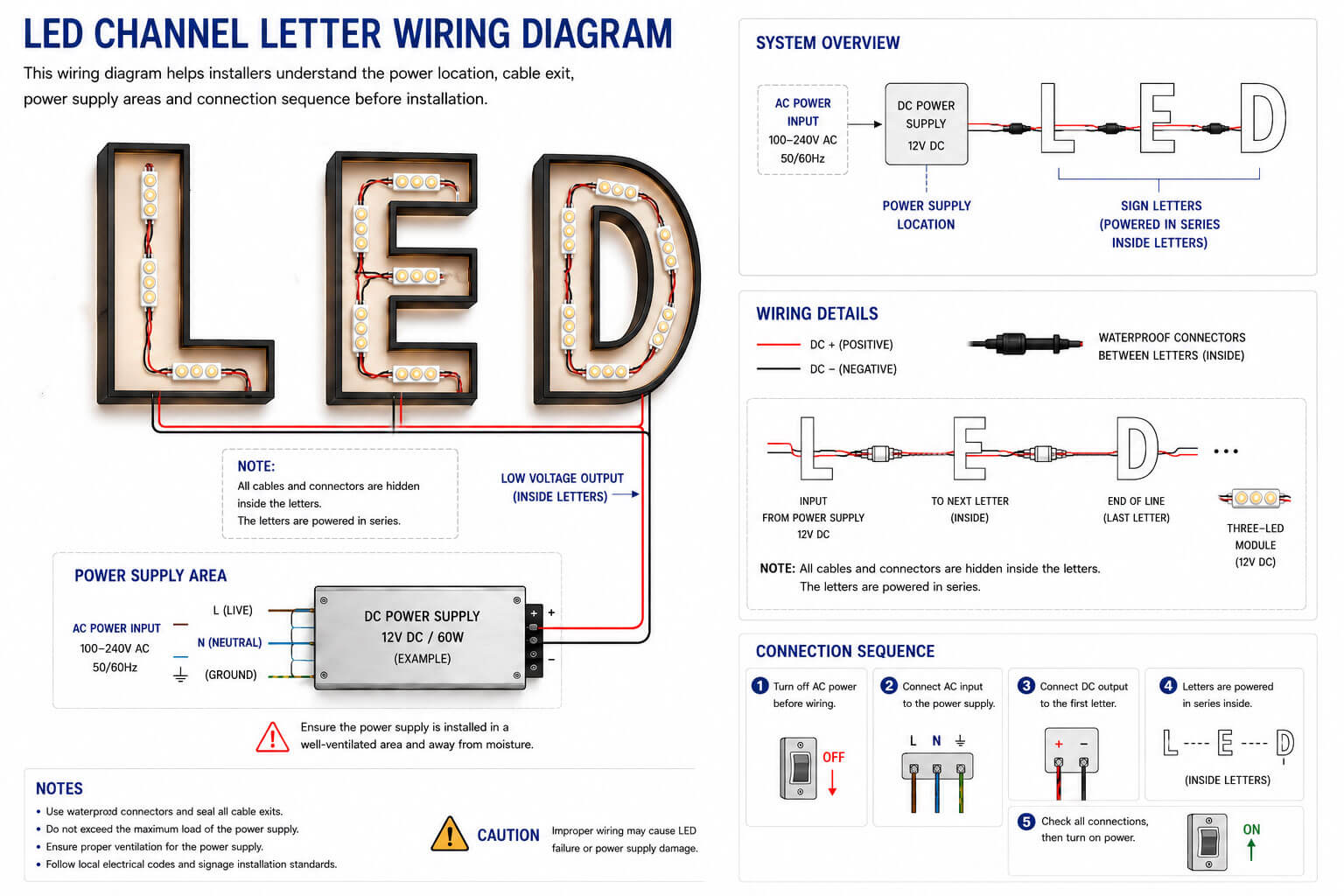
Table of Contents
- Why wiring diagrams matter before production
- What an LED sign wiring diagram should show
- 12V vs 24V wiring for illuminated signs
- How power supplies connect to LED letters
- Power zones for large channel letter signs
- Cable distance and voltage drop
- RGB and programmable LED sign wiring
- Outdoor waterproof wiring details
- What installers should check before power on
- Common wiring diagram mistakes
- What to send before ordering a custom LED sign
- FAQ
What an LED Sign Wiring Diagram Should Show
An LED sign wiring diagram should make the electrical layout easy to understand. It does not need to be overly complicated, but it should show the important connection points clearly enough for production, installation, and troubleshooting.
A practical LED sign wiring diagram usually includes:
- Sign layout and letter order
- LED voltage, such as 12V DC or 24V DC
- Power supply quantity and wattage
- Positive and negative output connections
- Cable exit positions
- Power supply location
- Cable route from power supply to letters
- Power zones or letter groups
- Controller position for RGB or programmable signs
- Notes for waterproofing and maintenance access
For a small indoor sign, the diagram may be simple. For a large storefront sign, facade sign, RGB sign, or programmable LED sign, the wiring diagram should be more detailed. The goal is to reduce guessing during installation.
Buyers do not always need to understand every electrical detail, but they should know whether the supplier has planned the wiring. A clear diagram helps the buyer communicate with the local installer, landlord, electrician, or contractor before the sign arrives.
For overseas projects, the LED sign wiring diagram also becomes a shared reference between the factory and the local installation team. This reduces misunderstandings when the installer cannot inspect the sign before delivery.
Why Wiring Diagrams Matter Before Production
Many wiring problems happen because the electrical layout is discussed too late. If the sign is already produced and the installer later discovers that the power supply location is too far away, the wall has no access space, or the cable exit is in the wrong position, the project becomes more difficult.
The LED sign wiring diagram should be considered before production because it affects the sign structure. Cable exits may need to be drilled in the back of the letters. Power wires may need to exit through a wall, raceway, or backer panel. Large signs may need several power zones. RGB signs may need controllers and signal wiring.
Early wiring planning helps confirm:
- Whether the sign uses 12V or 24V LEDs
- How many power supplies are required
- Where the power supplies can be installed
- Whether the sign needs one cable exit or several exits
- Whether cable distance may cause voltage drop
- Whether the wall needs drilling or hidden wiring access
- Whether outdoor components need waterproof protection
This planning is especially important for international projects. The factory may understand the sign structure, while the local installer understands the building site. A wiring diagram connects these two sides and makes the installation more predictable.
For broader installation planning, you can also read Retay Sign’s Illuminated Letters Installation and Wiring Guide.
12V vs 24V Wiring for Illuminated Signs
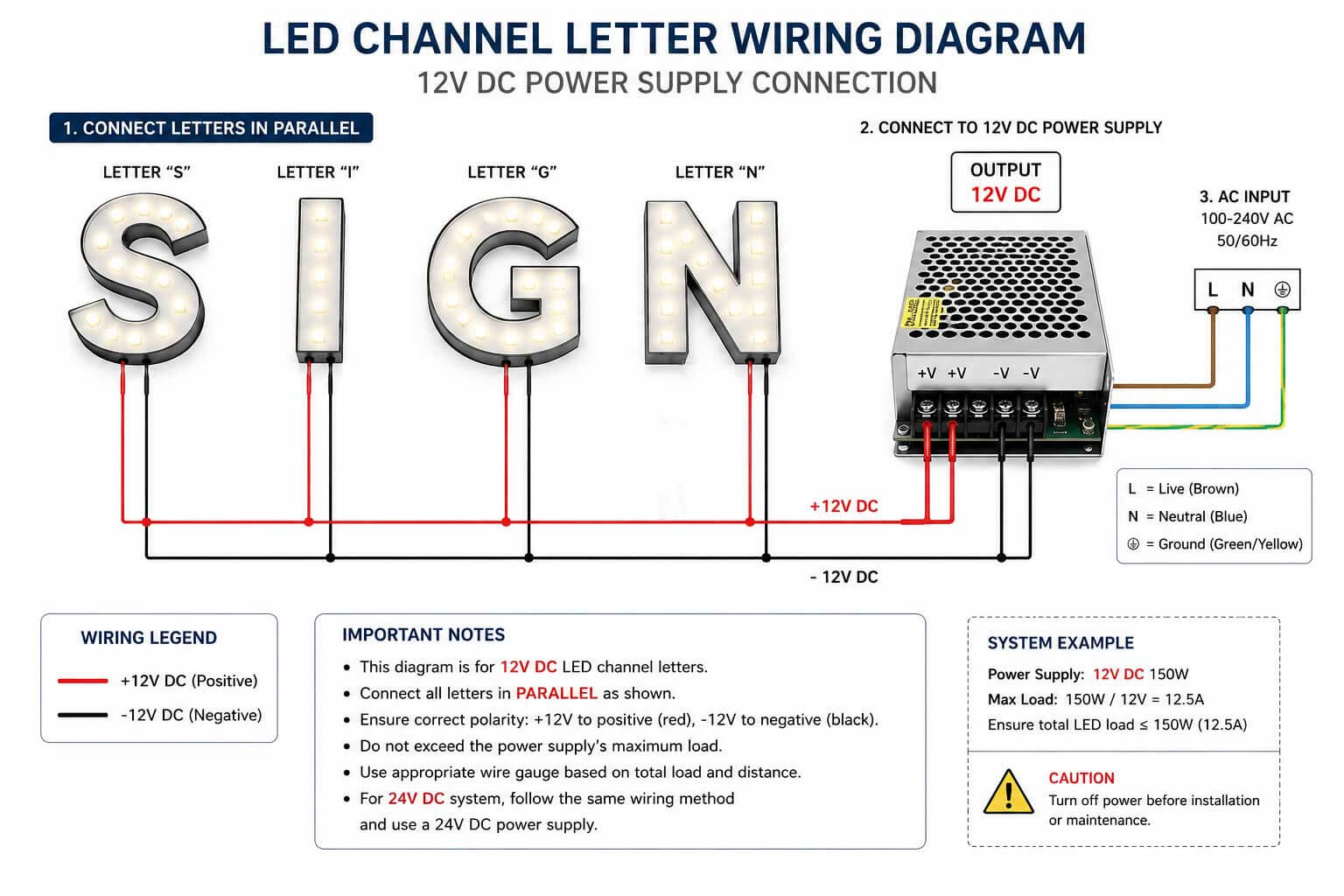
Most illuminated signs use low-voltage LED systems, commonly 12V DC or 24V DC. The LED modules and power supply must use the same voltage. A 12V LED module should connect to a 12V power supply. A 24V LED module should connect to a 24V power supply.
The voltage choice depends on the sign size, LED type, cable distance, and project requirements.
12V LED signs are common for smaller signs, indoor logos, short cable runs, and standard channel letters. They are widely available and practical for many storefront signs.
24V LED signs are often helpful for larger signs, longer cable runs, and projects where voltage drop needs better control. Because a 24V system can carry the same power with lower current than a 12V system, it may perform better over longer distances when designed correctly.
The wiring diagram should clearly show the LED voltage. If the voltage is not marked, the installer may connect the wrong power supply. That can damage the LEDs or create unstable brightness.
For safety, building-side electrical connections should follow local electrical codes and should be handled by qualified electricians or licensed installers when required. Low-voltage LED wiring still needs proper planning and protection.
You can learn more about electrical product safety and certification from UL Solutions. This is a useful external reference when a project needs recognized electrical safety documentation.
How Power Supplies Connect to LED Letters
A power supply converts building electricity into the low-voltage output used by LED modules. In an LED sign wiring diagram, the power supply is the starting point for the low-voltage wiring layout.
The diagram should show:
- Input side of the power supply
- Output voltage
- Output positive and negative terminals
- Which letters or zones each power supply feeds
- Cable direction from power supply to the sign
- Whether the power supply is inside a raceway, wall cavity, ceiling, cabinet, or electrical box
One common mistake is assuming one power supply can feed the whole sign without calculation. In reality, the power supply must match the total LED load and should not run at full capacity every day. A safety margin helps reduce heat stress and improves long-term stability.
Another common issue is placing the power supply too far from the sign. Long cable runs can cause voltage drop, especially if the cable size is not suitable. If the power supply must be installed far away, the wiring diagram should account for cable length, cable thickness, voltage, and power zones.
The power supply should also be accessible for future maintenance. A hidden power supply may look cleaner, but if it cannot be reached later, a simple repair can become expensive.
For this reason, the LED sign wiring diagram should show not only the electrical connection but also the service access point for the power supply.
Power Zones for Large Channel Letter Signs
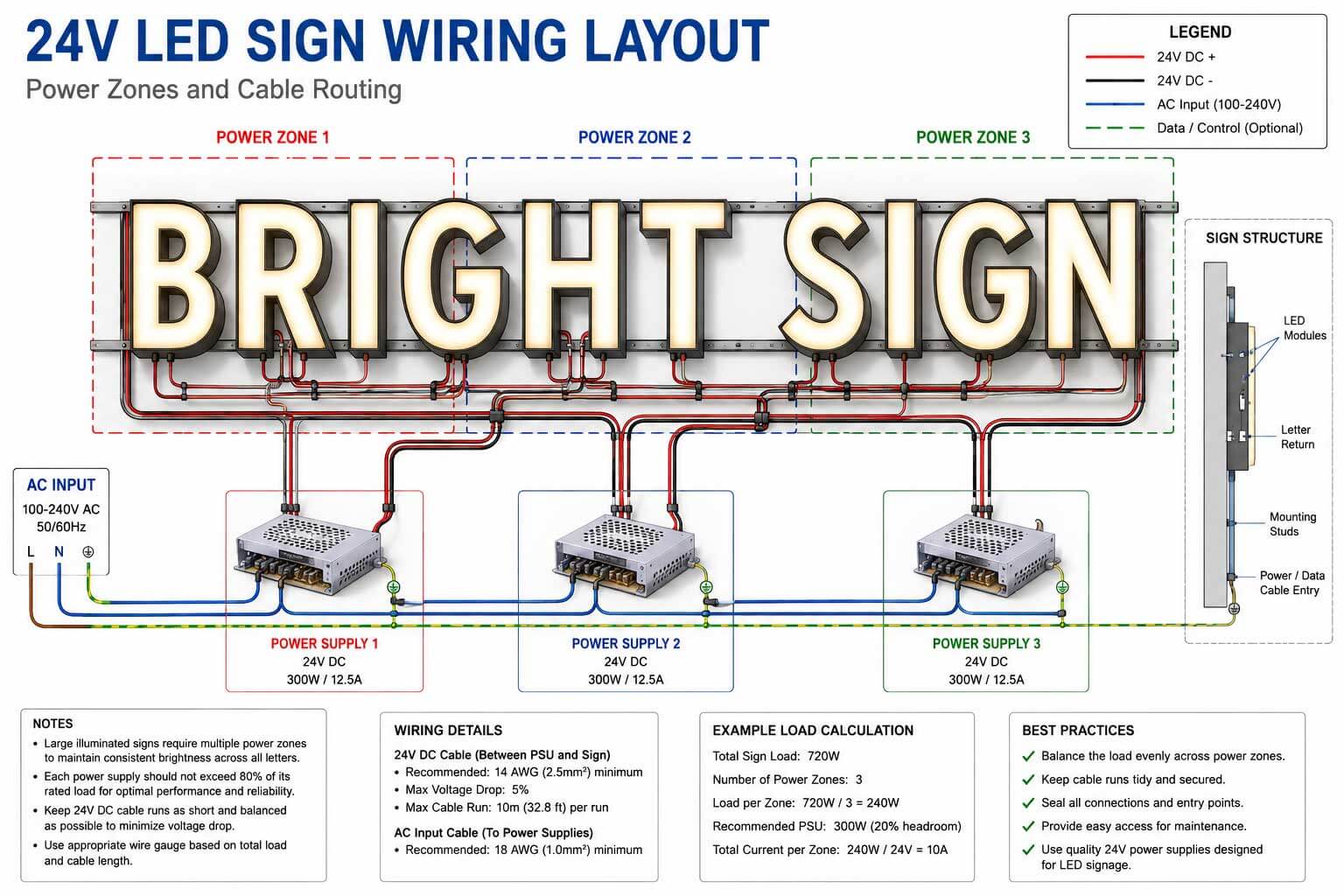
Large channel letter signs often need more than one power zone. A power zone is a section of the sign powered separately from other sections. Power zones help keep brightness even and reduce the load on each power supply or cable run.
When the LED sign wiring diagram separates a large sign into power zones, each installer can understand which letters belong to each circuit before connecting the cables.
For example, a long storefront sign may divide letters into left, center, and right zones. A large logo plus letters may use one power zone for the logo and another for the text. A very large facade sign may use several power supplies placed closer to different letter groups.
A channel letter wiring diagram should show power zones clearly. Each zone should identify which letters it feeds and where the power comes from. If a sign has multiple power supplies, each power supply should be matched with the correct zone.
Power zones are useful because they can:
- Reduce voltage drop
- Improve brightness consistency
- Make troubleshooting easier
- Reduce stress on a single power supply
- Allow large signs to be installed in sections
Power zoning is especially important for long LED runs, large letters, high-output LEDs, RGB lighting, and signs installed far from the power source.
Cable Distance and Voltage Drop
Voltage drop happens when electrical power loses strength as it travels through cable. In LED signs, voltage drop can make letters farther from the power supply look dimmer than letters closer to the power supply.
Voltage drop is affected by:
- Cable length
- Cable thickness
- Total LED power load
- Current
- Voltage
- Number of connection points
- Wiring layout
An LED sign wiring diagram should consider cable distance early. If the power supply is close to the sign, the layout is usually easier. If the power supply is far away, the supplier and installer should confirm whether the cable size, voltage, and power zones are suitable.
Ways to reduce voltage drop include:
- Use properly sized cable
- Keep power supplies closer to the sign when possible
- Use 24V LED systems when suitable
- Divide the sign into several power zones
- Add power injection points for long LED runs
- Avoid overloading one cable run
Voltage drop is not always visible during a quick daytime check. It is often easier to notice at night when the whole sign is lit. That is why final testing should include a nighttime brightness check when possible.
If the project has a long cable run, ask the supplier to mark cable distance assumptions on the LED sign wiring diagram before approving production.
RGB and Programmable LED Sign Wiring
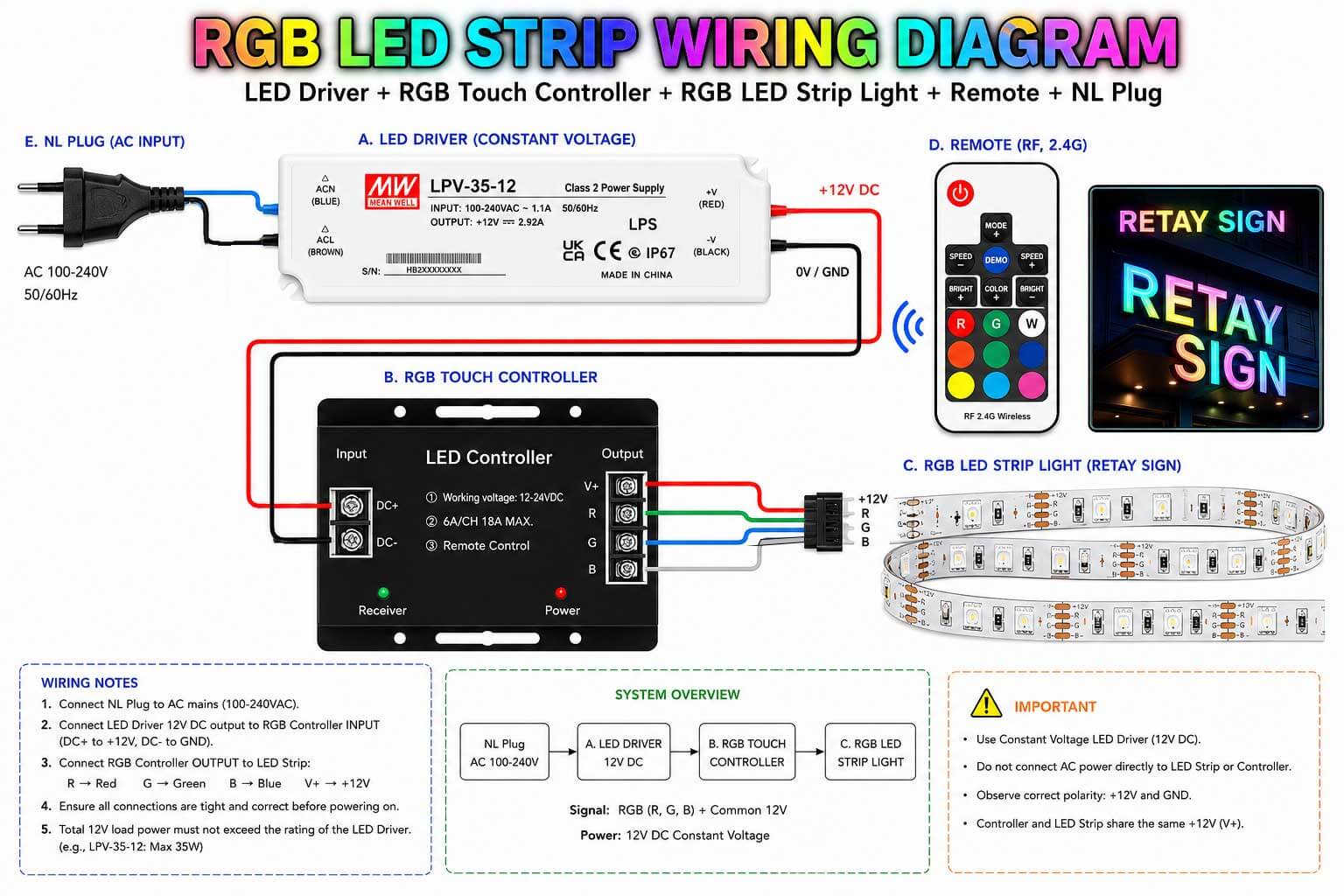
RGB and programmable signs need more planning than single-color LED signs. A simple white LED sign may only need positive and negative low-voltage wires. RGB signs may need a controller, extra signal wires, RGB or RGBW output channels, and sometimes a remote, app controller, DMX controller, or SPI pixel controller.
For RGB LED sign wiring, the diagram should show:
- LED type
- Controller location
- Power supply location
- RGB or RGBW output connections
- Signal direction
- Letter grouping
- Cable distance between controller and letters
- Power injection points if needed
Programmable LED signs can be more complex because different sections or pixels may be controlled separately. If the signal direction is wrong or the controller does not match the LED type, the lighting effect may not work correctly.
Before ordering RGB or programmable letters, confirm the lighting effect you want. A simple color-changing sign does not need the same wiring system as a sign with chasing effects, gradients, animations, or synchronized lighting scenes.
For color-changing projects, an LED sign wiring diagram should clearly separate power wiring from signal or controller wiring so the installer does not confuse the two.
For related control options, Retay Sign’s RGB article can be used as an internal reference: RGB / Programmable Letters: What Controllers and Options Matter.
Outdoor Waterproof Wiring Details
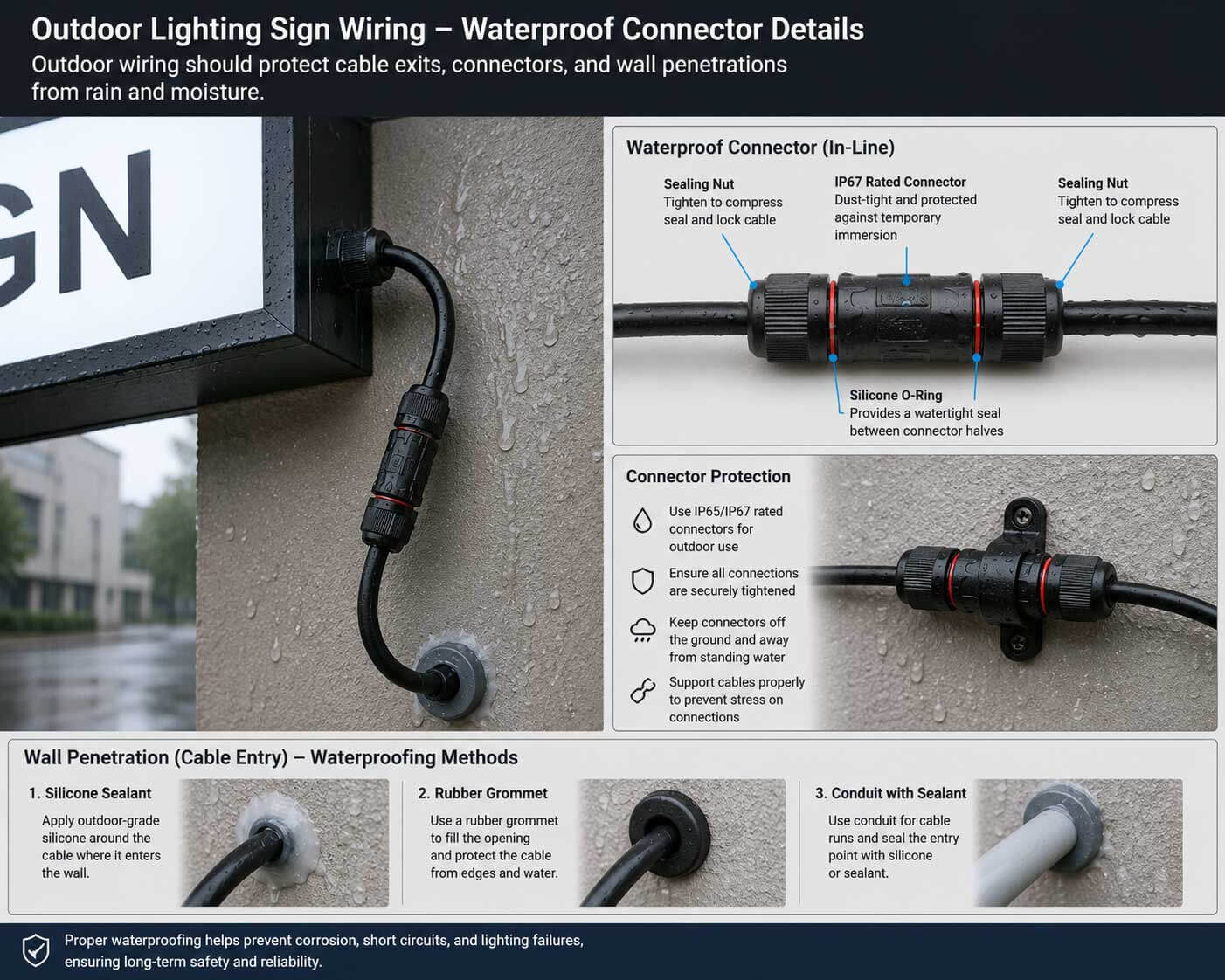
Outdoor illuminated sign wiring must be protected from rain, moisture, dust, UV exposure, and temperature changes. A wiring diagram should not only show electrical connections; it should also help installers understand where cables exit and where joints need protection.
Outdoor wiring details may include:
- Downward-facing cable exits
- Sealed wall penetrations
- Waterproof connectors
- Protected junction boxes
- Drip loops where appropriate
- Silicone sealing around cable holes
- Outdoor-rated power supplies or enclosures
- Cable routes that avoid standing water
Waterproofing is a complete system. Even if the LED modules are suitable for outdoor use, poor installation can still allow water to enter through screw holes, wall holes, cable exits, or open connectors.
Installers should avoid leaving exposed wire joints behind the letters. Cable joints should be protected inside suitable connectors or junction boxes based on the installation environment and local code.
If the sign is installed outdoors, the buyer should send wall photos and installation position photos before production. These photos help the factory plan cable exits and mounting points more realistically.
Outdoor projects should include waterproof notes directly on the LED sign wiring diagram, especially when the cable exits pass through a wall or metal raceway.
What Installers Should Check Before Power On
Before turning on power, installers should carefully check the wiring. This is especially important for large signs, outdoor signs, RGB signs, and projects with several power supplies.
Before power on, confirm:
- The power supply output voltage matches the LED modules
- Positive and negative polarity are correct
- Cable connections are tight
- No wire is pinched behind the letter
- No exposed conductor is visible
- Power supplies are not overloaded
- Outdoor connections are protected
- The power supply has ventilation and maintenance access
- The controller matches the LED type if RGB or programmable lighting is used
- The wiring diagram matches the actual installation
After power on, check whether every letter lights correctly. Look for flickering, weak brightness, uneven color, overheating, or unusual behavior. For RGB signs, test several colors and modes, not only one static color.
If a section does not light correctly, turn off power before checking connections. Repeatedly powering an incorrectly wired sign may damage LEDs, controllers, or power supplies.
During troubleshooting, compare the real connection with the LED sign wiring diagram first. This simple step often reveals reversed polarity, missing power zones, or controller wiring mistakes.
Common Wiring Diagram Mistakes
A wiring diagram should make installation easier. If it is unclear, incomplete, or wrong, it can create confusion on site.
Common mistakes include:
- Not marking the LED voltage
- Not showing positive and negative wires clearly
- Using one power supply for too many letters
- Ignoring cable distance
- Not dividing large signs into power zones
- Showing the power supply in a location that is not accessible
- Forgetting RGB controller wiring
- Not showing cable exits
- Not adding waterproof notes for outdoor signs
- Changing the sign design without updating the diagram
Another common mistake is treating the wiring diagram as only an electrical drawing. For signs, the wiring diagram should connect electrical planning with physical installation. It should match the actual letter backs, mounting method, wall access, and power supply location.
Before production starts, the buyer should approve the final LED sign wiring diagram together with the sign drawing, especially for large or outdoor projects.
What to Send Before Ordering a Custom LED Sign
To prepare a useful LED sign wiring diagram, the supplier needs accurate project information. The more complete the information, the easier it is to design the right wiring layout.
Before ordering, send:
- Logo file or sign design
- Required sign size
- Letter height and depth if known
- Indoor or outdoor use
- Wall photos and installation position
- Wall material if known
- Lighting type: front-lit, backlit, side-lit, RGB, or programmable
- Local input voltage, such as 110V or 220V
- Preferred power supply location
- Approximate distance from power supply to sign
- Installation method, such as studs, spacers, raceway, or backer panel
- Any landlord, contractor, or electrical code requirements
If you do not know the best wiring solution, send the project information and ask the supplier to recommend one. A professional signage manufacturer can help choose the LED voltage, power supply capacity, cable exit positions, and wiring layout based on your sign size and installation environment.
With complete site information, Retay Sign can prepare an LED sign wiring diagram that is easier for your local installer to follow.
LED Sign Wiring Diagram Checklist
| Item | What to Check | Why It Matters |
|---|---|---|
| LED voltage | 12V or 24V clearly marked | Prevents wrong power supply connection |
| Power supply | Quantity, wattage, and location | Helps avoid overload and maintenance issues |
| Polarity | Positive and negative wires shown | Reduces wiring mistakes |
| Cable exits | Position marked on sign layout | Helps installers drill and route cables correctly |
| Power zones | Large signs divided logically | Improves brightness consistency |
| Cable distance | Route and length considered | Helps reduce voltage drop |
| Controller | RGB or programmable controller shown | Ensures effects work correctly |
| Waterproofing | Outdoor cable protection noted | Reduces water damage risk |
| Testing | Factory and site testing planned | Confirms stable lighting before handover |
FAQ
What is an LED sign wiring diagram?
An LED sign wiring diagram is a drawing or layout that shows how LED modules, power supplies, cables, controllers, and sign letters should be connected. It helps the installer understand voltage, polarity, cable exits, power zones, and power supply locations.
Do all LED signs need a wiring diagram?
Small indoor signs may only need a simple connection guide, but most illuminated signs benefit from a wiring diagram. Large channel letters, outdoor signs, RGB signs, programmable signs, and signs with multiple power supplies should always have a clear wiring diagram.
Is 12V or 24V better for LED sign wiring?
Both can work well when designed correctly. 12V is common for smaller signs and short cable runs. 24V is often useful for larger signs or longer cable distances because it can help reduce voltage drop. The LED modules and power supply must always use matching voltage.
Why do some LED letters look dimmer than others?
Uneven brightness may be caused by voltage drop, undersized cables, overloaded power supplies, poor power zoning, loose connections, or incorrect LED layout. A proper wiring diagram can reduce these risks before installation.
Can RGB LED signs use the same wiring as white LED signs?
No. RGB and programmable signs usually need controllers and extra wiring for color channels or signal control. The wiring diagram should show the controller, power supply, signal direction, and any power injection points.
What information does Retay Sign need to prepare a wiring diagram?
Please send your logo file, sign size, wall photos, installation location, lighting style, local voltage, power supply location, cable distance, and any special installation requirements. These details help us recommend the right LED sign wiring layout.
Conclusion
A clear LED sign wiring diagram helps prevent installation mistakes before they happen. It shows how the sign should be powered, where cables should exit, how letters should be grouped, and how installers should connect the system safely.
For LED channel letters, backlit signs, RGB letters, light boxes, and outdoor illuminated signs, wiring planning should begin before production. The right voltage, power supply location, cable route, power zones, waterproof details, and final testing all affect the sign’s long-term performance.
Retay Sign manufactures custom illuminated signs for international projects and can help prepare practical wiring layouts based on your logo, sign size, wall photos, power location, and lighting requirements.
Send us your design, dimensions, installation photos, power supply position, and preferred lighting effect. Our team will help you plan a stable LED sign wiring solution for your project.
If your project needs a custom LED sign wiring diagram, include the wall photo, power position, and cable distance in your inquiry so our team can review the wiring layout before quotation.